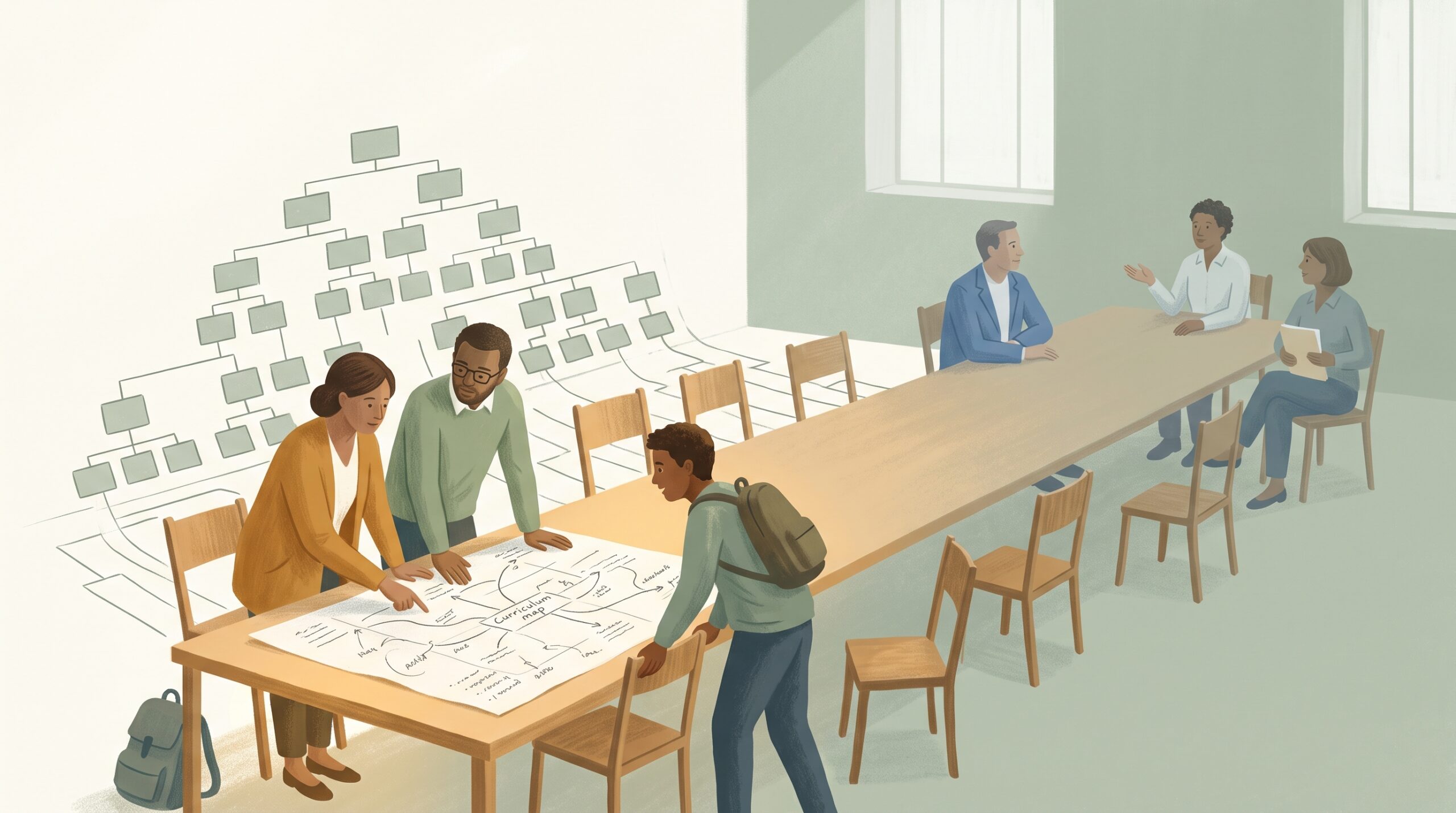
Change in education lands best when the people who teach help shape it from the first sketch. That asks something of everyone behind them.
When anatomy teachers at an Australian university, in Colasante’s (2025) study, were told to replace their lectures with digital alternatives, they went well beyond the instruction. They designed their own pedagogical models and built the routines that kept the new practice going. But all that agency arrived after the decision had been made. Had they been invited at the start, the same teachers might have shaped the decision itself.
This post is about that gap. My argument is simple: who sits at the table, and when, decides how well change lands in education. Invite teachers and educational developers while an idea is still unfinished. And organise the institution so that the people who teach steer the services behind them, not the other way round. That holds for universities, and just as much for schools, vocational colleges and any institution where teaching is the core of the work.
Teachers often arrive after the decision
Usually nobody means to leave teachers out. Attention simply drifts to everything around teaching. A European University Association peer group described universities as “typically process-heavy”, and noted that staff development has yet to find its place in those processes (European University Association, 2026). Risk management, compliance and audits all claim time, much of it rightly. Teaching starts to feel like a given, and the people closest to it end up outside the room.
AI is a telling example. Marc Watkins (2026) notes how rarely faculty are included in institution-wide conversations about buying AI licences, and points to Kathryn Conrad’s advice on what to ask when vendors come calling. The contract reaches teachers as a finished fact.
Why timing matters
Weick (1976) called schools and similar organisations loosely coupled: their parts respond to one another, yet each keeps its own identity. The head’s office and the classroom are connected, but the link is weak and slow. A decision taken in one place reaches classrooms late, and usually in altered form, which is why administrators are so often surprised when things never happen the way they were supposed to. The same looseness has real benefits. It lets teachers adapt to local situations, gives them room to decide for themselves, and keeps a problem in one corner from spreading. Its cost is that a good solution found in one classroom rarely travels to the next.
In a system like that, change travels along lines of shared meaning. Kezar and Eckel (2002) studied 23 American colleges and universities in a national change project, every one of them with a plan for deep change. After four years, only six had made clear progress. What made the difference in those six was sensemaking: people kept getting occasions to rethink their roles, skills and approaches, and to work out together what the change meant for their own work. A recent study of digitalisation strategies at three research universities in Germany, Estonia and the UK points the same way. Where a strategy connected with what staff already valued, it helped them make sense of new practice. Where leadership sent mixed messages, staff started explaining things to one another instead (Laufer et al., 2026).
Sensemaking happens anyway. The only question is where, and when.
Bring people in early, and their sensemaking shapes the change before a plan fixes the frame. Leave them out, and it happens anyway: in corridors, after the fact.
What a good table does
At Macquarie University, Burrell and colleagues (2015) studied five teams of academics, educational developers and technical specialists who designed online units and a degree programme in philosophy, history and languages. Working this way, they suggest, can move ownership of a curriculum, including its upkeep and improvement, from one academic to the group.
The quality of the collaboration matters too. In seven design teams at six UK universities, Papageorgiou and Bennett (2026) found that the productive ones grew through relational work: people learning what each brought, letting roles stretch, covering one another’s gaps. The best teams became places of professional learning for everyone in them.
That is also what draws teachers in. Asked why they took on informal pedagogical leadership, 45 academics kept naming two motives: enabling learning, for students and colleagues, and their own professional development (Kalman et al., 2026). An invitation to shape a change speaks to both.
Teams like these cut across the organisation chart, so they seldom form by themselves. Someone has to convene them, and the organisation has to make room for them.
Tip the pyramid on its side
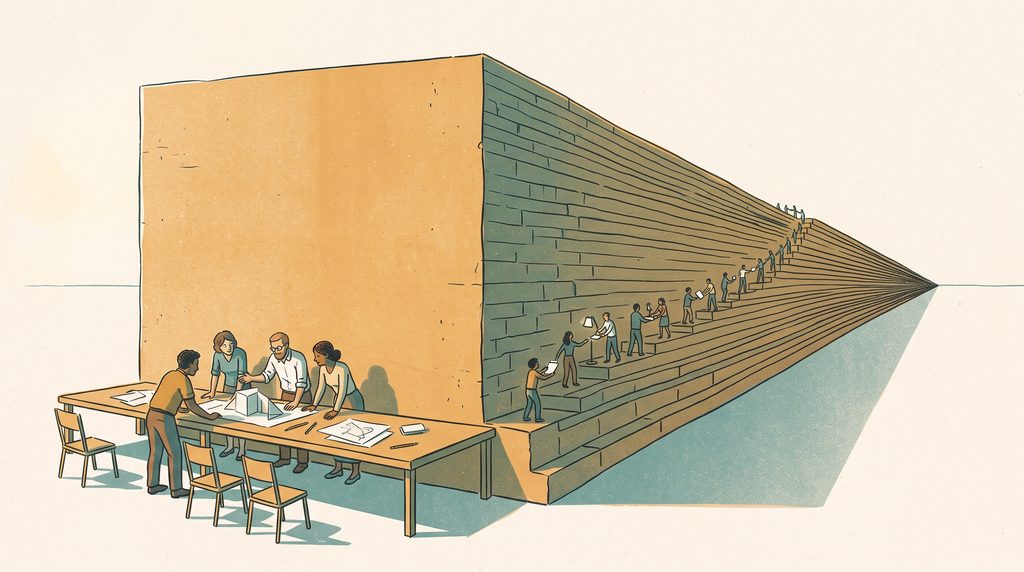
Rhineland organising, a Dutch tradition built on craftsmanship and professional judgement, offers a useful picture (Peters & Weggeman, 2019). Take the familiar hierarchy and lay it on its side. The organisation now runs from front to back: the professionals who do the primary work stand at the front, and management and support services stand behind them, making that work possible. The front steers the back.
In Het Rijnland veranderboekje, a small workbook on changing organisations the Rhineland way, Peters and Weggeman (2017) describe change as something that happens continuously, a little every day, through an organisation’s own consultation and decision-making structures. Responsibility stays inside. Few organisations are as full of professionals as educational ones, which makes the fit a natural one.
In education, the front is easy to find: the teacher in front of a class, the programme team rethinking its assessment. Right behind them sit the learning designers, educational developers and technologists, who often hear first what the front needs. In a study of Israeli teaching centres, Bitar and Davidovitch (2026) found that the successful ones move institutions without formal authority by building networked legitimacy through relationships that span the hierarchy. In tilted terms, they are the part of the back closest to the front.
So most institutions already have the people for a good table. The first task is to see them.
What steering from the front asks
In a tilted institution, what teachers and programme teams need sets the agenda for everything behind them: which support gets built, where time and budget go, which systems are bought, which rules are worth keeping. Management holds the shared ambition and the frame around it. Peters and Weggeman (2017) call this top-level sport, for the back and especially for the front.
For the back, it means time at the workbench. That could mean sitting in on the meeting where a new assessment is wobbling, or staying with a teacher who is unsure what generative AI will do to an essay-based course. Teachers improvise constantly, reading a room or reshaping a task mid-term, and that professional improvisation is key. Taken seriously as evidence, it shows the back what genuinely supports the front.
For leadership, it means steering four things and leaving the rest to the front:
| Steer on | What helps | What gets in the way |
|---|---|---|
| Direction | Setting a direction and explaining why it matters | Settling on a solution first, then looking for buy-in |
| Conditions | Creating time, mandate and room to try | Prescribing how each course is taught |
| The table | Choosing who sits at it, and when | A consultation round once most choices are made |
| Learning | Learning from what happens and adjusting course | Reading login counts as a sign of adoption |
Notice what is missing from that list: the how. How a programme team organises its work, who picks up what, when they meet, which route they take to the goal and which steps they skip: that belongs to the professionals themselves. In a process-heavy institution, the reflex is to add templates, approval rounds and project plans. Leadership can agree on what needs to happen and why, then trust the people doing the work to find the best way to get it done.
How an institution changes also shapes what it becomes. A Rhineland way of working, the booklet warns, cannot be reached through five steps ending in “implementation” (Peters & Weggeman, 2017). An institution that wants ownership and professional judgement in its teaching has to practise both in the way it changes.
Setting the table
Who gets invited is half the work. How they are asked is the other half. “Please run a workshop on the new tool by March” seats an educational developer as an implementer. “Our first-year results puzzle us; can you help us understand them?” seats the same person as a professional whose judgement counts.
The best questions hand over the pen along with the problem:
- How would you describe this problem? Whoever names a problem shapes its solutions.
- What have you seen elsewhere that we should borrow, or avoid? This taps the cross-institutional view that educational developers bring.
- Which part of this should be yours to decide? Autonomy, offered out loud.
- What should stay exactly as it is? The front knows where good practice lives.
- Where do you need more room, and what in our support gets in your way? The tilted organisation in two questions.
Two habits help as well:
- Choose the chairs on purpose. Someone who can decide, teachers who will carry the change, an educational developer who has seen it elsewhere, and students whenever it touches their learning.
- Protect quiet seasons. People can absorb only so much change at once (Peters & Weggeman, 2019). Sometimes the best steering decision is a term without reorganisation.
Seen from the side
Drawn as a pyramid, an educational institution seems to invite steering from the top. Tipped on its side, it shows where education is actually made: in classrooms and programme teams, and in the conversation between a teacher and a learning designer about where students get stuck.
Colasante’s anatomy teachers showed what the front can do with a finished decision. Imagine what it could do with an open question. Set the table early, while the chairs are still empty. The people who make the education will fill them.
References
- Bitar, N., & Davidovitch, N. (2026). The change architects: Reimagining centers for teaching and learning as catalysts for 21st-century higher education transformation. International Journal for Academic Development, 31(2), 191–208. https://doi.org/10.1080/1360144X.2025.2566661
- Burrell, A. R., Cavanagh, M., Young, S., & Carter, H. (2015). Team-based curriculum design as an agent of change. Teaching in Higher Education, 20(8), 753–766. https://doi.org/10.1080/13562517.2015.1085856
- Colasante, M. (2025). Examining agentic actions: University teachers learning to embrace digital change. Studies in Technology Enhanced Learning, 4(3). https://doi.org/10.21428/8c225f6e.d4935933
- European University Association. (2026). Ensuring the quality and impact of staff development in teaching (Learning & Teaching Paper No. 28). https://www.eua.eu/publications/reports/ensuring-the-quality-and-impact-of-staff-development-in-teaching.html
- Kalman, E., Wright, M. C., & Wheeler, L. (2026). Why faculty lead: Motivations and benefits for informal pedagogical leadership. International Journal for Academic Development, 31(2), 303–319. https://doi.org/10.1080/1360144X.2026.2655924
- Kezar, A., & Eckel, P. D. (2002). Examining the institutional transformation process: The importance of sensemaking, interrelated strategies, and balance. Research in Higher Education, 43(3), 295–328. https://doi.org/10.1023/A:1014889001242
- Laufer, M., Kuper, F., Deacon, B., Sievering, M., & Schäfer, L. O. (2026). Strategic ambiguities: Exploring the role of digitalisation strategies in university teachers’ engagement with educational technology. European Journal of Higher Education, 16(1), 62–80. https://doi.org/10.1080/21568235.2025.2486788
- Papageorgiou, V., & Bennett, S. (2026). Can online learning design be truly collaborative in higher education? Insights from educators and digital learning professionals. Australasian Journal of Educational Technology, 42(2), 1–17. https://doi.org/10.14742/ajet.11192
- Peters, J., & Weggeman, M. (2017). Het Rijnland veranderboekje [The Rhineland change booklet]. Business Contact.
- Peters, J., & Weggeman, M. (2019). Het grote Rijnlandboekje [The big Rhineland book]. Business Contact.
- Watkins, M. (2026, February 15). Before you buy AI for your campus, read this. Rhetorica. https://marcwatkins.substack.com/p/before-you-buy-ai-for-your-campus
- Weick, K. E. (1976). Educational organizations as loosely coupled systems. Administrative Science Quarterly, 21(1), 1–19. https://doi.org/10.2307/2391875
Where this note connects
Open in the knowledge graphLinked notes
Threads ideas this note shares with others · pick one
Theme · also in Institutional AI Governance See this thread in the graph →
Theme · also in Decider vs Implementer Divide See this thread in the graph →
Theme · also in Measurement Blind Spots See this thread in the graph →
Theme · also in Myth of Plannable Change See this thread in the graph →
Theme · also in Primacy of the Primary Process See this thread in the graph →
Theme · also in Professional Autonomy and Craftsmanship See this thread in the graph →
Theme · also in Centres for Teaching and Learning See this thread in the graph →
Framework · also in Collective Sensemaking See this thread in the graph →
Framework · also in Middle-Out Change See this thread in the graph →
Framework · also in Networked Legitimacy See this thread in the graph →
Framework · also in Rhineland Organising See this thread in the graph →
Question · also in Early Involvement in Decisions See this thread in the graph →
Methodology · also in Deceleration and Quiet Seasons See this thread in the graph →
Methodology · also in Students as Partners See this thread in the graph →