The Courage to Wander
As a native Flemish speaker, I am often disarmed by the way my neighbours in the Netherlands use language. They have a distinct knack not just for coining brilliant terms, but for casually dusting off older, deeply resonant words that I had entirely forgotten existed. Together, these words capture the messy human reality of work, cutting straight through standard corporate jargon.
It is a welcome relief. In certain corners of our institutions, I often sense a quiet yearning to drop the heavy armour of the steering group or stuurgroep, the working group or werkgroep, and the risk assessment or risicoanalyse. These are mostly globalised business concepts in translation, walking around in very serious suits. Deep down, I think many of us miss the simpler, earthier words that belonged to our trades long before management became an industry of its own.
I recently came across a brief exchange on LinkedIn between the Dutch thinkers Harry Starren and Mathieu Weggeman that perfectly captures this desire to step off the formal map. Starren wrote profoundly about the discoveries we make only when we stop marching. He called this flaneren, the art of strolling without a destination while paying deep attention to whatever crosses your path. To capture the essence of this, he used a wonderfully clever play on words. He took the Dutch word for aimless, doelloos, and simply split it in two: doe loos. By isolating the word for do and the word for without, he transformed a term about lacking direction into a beautiful invitation to be without doing.
Weggeman expanded on this with an even earthier Dutch word: banjeren. To a native ear, this implies a slightly clumsy, unrefined, or lumbering movement. It is an aimless wandering that is completely unbothered by looking elegant.
These words feel like they belong to a breathing human being. They leave the door wide open for serendipity, inviting the toevalstreffer, that beautiful lucky strike a rigid plan would immediately filter out as an inefficiency.
Institutions naturally struggle with this aimlessness. When an organisation enters a threshold, when the old way of working has visibly fractured but the new way has not yet formed, a very human discomfort kicks in. Because leaders carry the heavy responsibility of guiding their teams, this uncertainty can understandably trigger a protective response. Out of a sincere desire to help and fix things quickly, the urge is to reach for an immediate solution that might not necessarily be what is actually needed. They might lean on a familiar diagram, outline a strict timeline, or gather another steering group.
But marching assumes human reality will behave like a complicated mechanical puzzle. It assumes the terrain will hold still while you follow the design. It never does. Every move shifts the ground just enough that your next step cannot be read off the original map.
The Dutch corporate anthropologist Jitske Kramer points out how tempting it is to manage these transitions by optimising our way out of the fog. Instead, she suggests a much braver opening move for deep change: erken dat je verdwaald bent, recognising that you are lost. Admitting this is incredibly difficult because, as she compassionately notes, our previous plans were built with the absolute best of intentions. Letting go of them hurts. Yet, saying it out loud does work that a formal presentation never can. It gives people permission to stop performing a confidence that nobody actually feels. It allows a group to collectively exhale.
Once the illusion of the formal map drops, you begin to notice where the actual navigation takes place. It rarely happens in the brightly lit room where the grand design is unveiled. When people finally admit they are lost, they stop staring at an empty timeline and start looking at the ground under their feet and at the colleagues standing right next to them. The true meaning of a transition is always negotiated in the smallest margins of the official agenda. It is the unspoken consensus reached over a spilled cup of coffee, the gentle reassurance shared just outside the room after a heavy announcement, the honest questions asked only when the microphone is turned off. This is where the real compass is calibrated.
Leaders who fill every calendar slot and every spare moment with scheduled tasks are closing off the only unhurried spaces their colleagues have left to work out what is actually going on. We often fear these unstructured moments because they look like a failure of direction. But as J.R.R. Tolkien famously wrote, not all those who wander are lost. In the messy reality of transition, wandering and being lost might look identical from a distance, yet they are profoundly different. Being lost is the anxious feeling of trying to force a broken map to work. Wandering is what happens after you admit the map is gone. It is a deliberate, attentive engagement with the unknown, proving that you are no longer lost, but simply moving beyond the edges of the familiar world.
This kind of wandering is not procrastination. It sits much closer to craftsmanship. It is a kind of bricoleren, the deeply human art of tinkering and piecing a path forward together from whatever materials happen to be at hand.
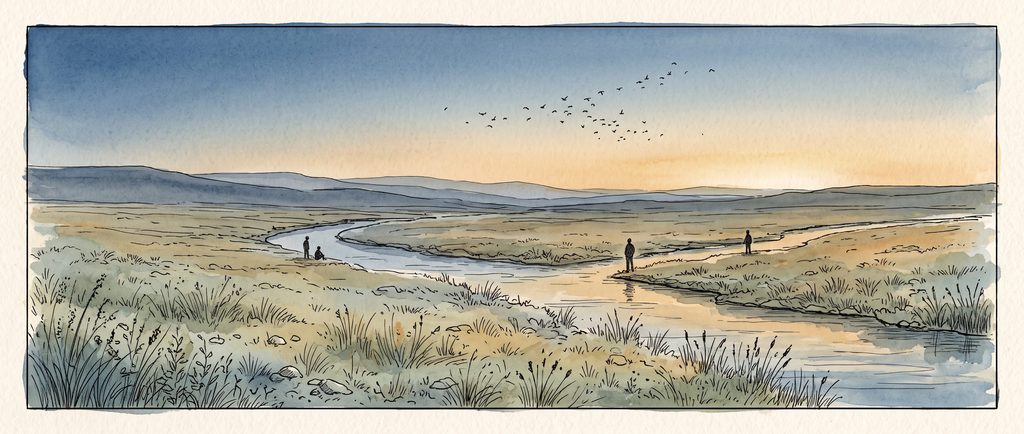
There is a profound power in simply acknowledging the pathways we have already chosen. When the relentless push for the next milestone softens, we can finally pause, look around, and realise that this very moment is also it. It is actually quite beautiful here. Allowing people to just enjoy the view creates the exact spaciousness required for true professional improvisation. Only when we stop forcing a predetermined route do fresh, unexpected paths gently present themselves.
The people who successfully guide colleagues through deep change are what Kramer calls masters of ceremony for the space in between. Their job is not to dictate the route or draft another risk analysis. Their job is to stay present long enough, and honest enough, that the group does not have to pretend it can see further ahead than it actually can. They walk the threshold with people, taking the next right step, and gently naming the terrain as they go.
Further readings & inspiration
- “De mythe van maakbare verandering in organisaties,” AWVN, 2026. https://www.awvn.nl/arbeidsverhoudingen/publicaties/de-mythe-van-maakbare-verandering-in-organisaties/
- Jitske Kramer, interviewed in “‘Erkennen dat je verdwaald bent, daar begint het mee,'” Boom Management, 2025. https://www.linkedin.com/pulse/erkennen-dat-je-verdwaald-bent-daar-begint-het-mee-jitske-kramer-5z7me/
- Adrianna Kezar, “Leading in the Liminal Space,” Change: The Magazine of Higher Learning, 58(3), 2026.https://doi.org/10.1080/00091383.2026.2657771
- Remco Coppoolse, Lydia Schaap, and Kristin Vanlommel, De grote vragen over onderwijsinnovatie: Op zoek naar meer verandergoesting. Boom, 2023. https://www.boom.nl/hoger-onderwijs/100-18730_De-grote-vragen-over-onderwijsinnovatie
- Jaap Peters and Mathieu Weggeman, Het Grote Rijnlandboekje. Business Contact, 2019. https://www.boom.nl/management/100-8843_Het-Grote-Rijnlandboekje
Click any node to navigate · drag to explore
Part of these threads
Connected notes