We don't reason our way into new behaviour. We act, uncertainly and messily, and then make sense of it by telling a story about what happened. I keep coming back to this when I watch institutions respond to AI and other challenges. Sensemaking is retrospective. Strategy is prospective. The gap between them is where people get lost.
A new booklet from Boonstra and Dubbeldam, Korte verhalen over de toekomst van veranderen (Short stories about the future of change), gathers practitioners rethinking the field of organisational change. Steven van den Heuvel puts it plainly in his contribution. Identity isn’t a fixed thing that change happens to. We don’t first exist and then tell stories about ourselves — we come into being through them. “Identiteit is narratief” — identity is narrative. Disrupt those stories, and you’ve disrupted something more fundamental than a workflow.
Jorrit Stevens, in the same volume, locates the disruption not in any single bad decision, but in the verb itself. ‘Change’ has become a normative principle — it makes the present permanently insufficient and quietly determines what counts as reasonable, professional, and responsible behaviour. Whether the approach is agile transformation, appreciative inquiry, or bottom-up emergence: “De verpakking verandert, het werkwoord niet.” The packaging changes, the verb doesn’t. The alternative starts from a different premise — that people are subjects of change rather than objects of it, that hesitation carries information worth listening to, and that standing still sometimes looks a lot like paying attention.
Change can be mandated from the top — but meaning can’t. Green and Little (2013) describe academic developers, and by extension anyone in a hybrid educational role, as working from a position of marginality that is “simultaneously peripheral and vital.” It’s from that position, not from the top, that different meanings can first be made discussable. Bitar and Davidovich (2026) found something similar: teaching and learning centres drive institutional transformation through middle-out processes, building what they call “networked legitimacy” across hierarchies, not through formal authority, but through sustained relationships.
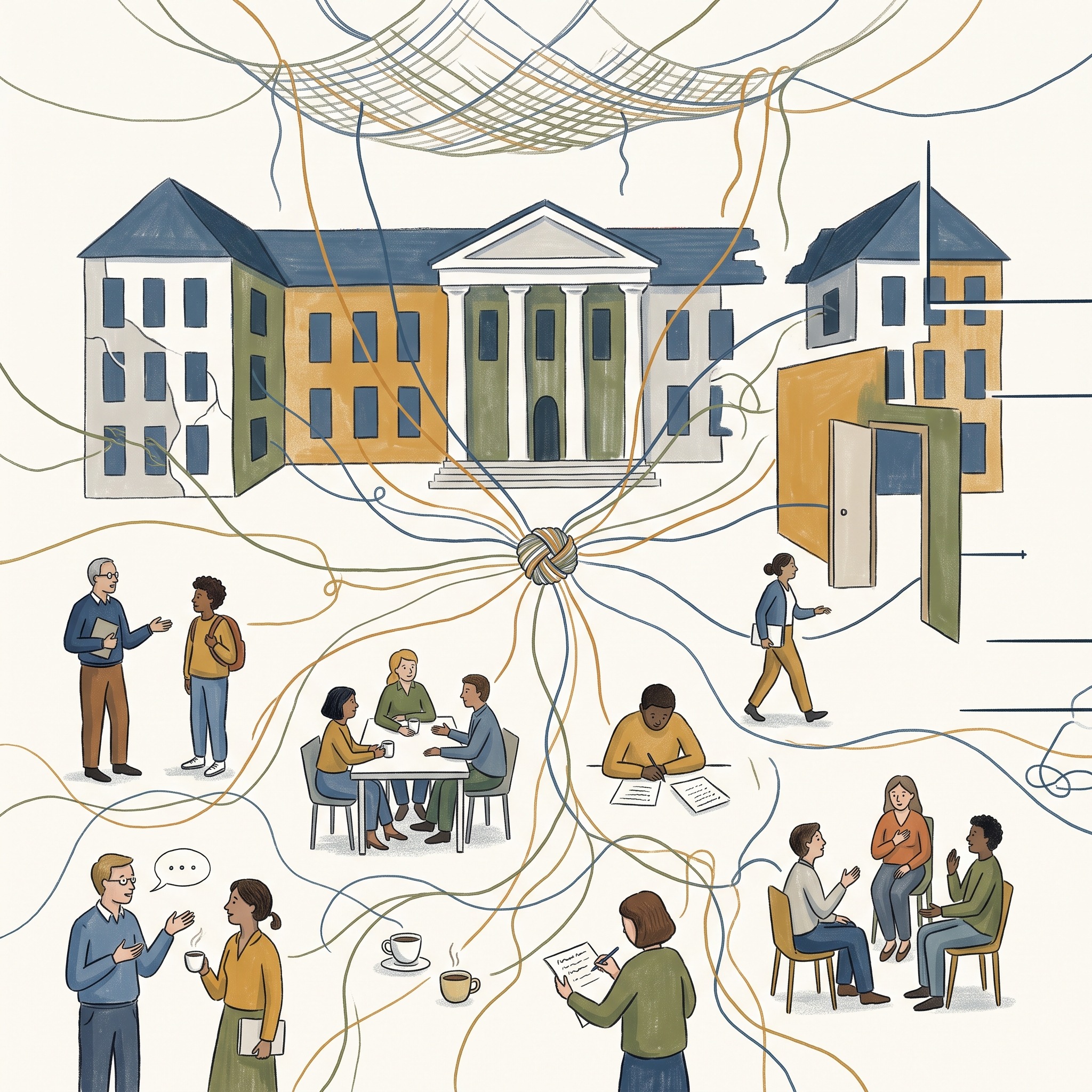
Those connections don’t maintain themselves. Vermaak, in the Dutch booklet about change, argues for what he calls verbindingswerk: the deliberate craft of weaving ties across practices alongside one’s own local work — a lappendekenperspectief where distributed action and many small threads achieve what a large central program never could. His argument is about societal transitions, but the logic holds closer to home too. “Maar juist door die taken zo scherp te beleggen en verantwoordelijkheden te begrenzen, snijden we veel verbindingslijntjes door. En daar gaat dan niemand meer over” — by sharpening roles and bounding responsibilities, we cut the threads that nobody officially owns. My reading: clear roles and plans are valuable and make work achievable, but when they become too restrictive, they risk crowding out exactly the informal connections no job description can capture. Vermaak is also clear that verbindingswerk is not gentle work — connecting across practices stirs things up, confronts worlds, and disturbs established relations. Closer to what Stevens calls interrupting the discourse than to anything administrative.
All of which raises a different question: not what changes, but what holds. Whitsed and colleagues (2024) asked academics exactly that: what carried them through years of institutional upheaval. The answers clustered around joy in students, in teaching, in colleagues: the relational, the recognised. What sustains people through change, it turns out, is exactly what tends to get cut first. It’s the sense that what they do still means something, and that someone else recognises it.
So perhaps the institutions navigating this moment well are the ones where meaning still has room to move, where connections haven’t been optimised away, and where hesitation isn’t immediately converted into an action point. How wonderful that would be.
Further reading
Bitar, N., & Davidovitch, N. (2026). The change architects: Reimagining centers for teaching and learning as catalysts for 21st-century higher education transformation. International Journal for Academic Development, 31(2), 191–208. https://doi.org/10.1080/1360144X.2025.2566661
Boonstra, J., & Dubbeldam, M. (Eds.). (2026). Korte verhalen over de toekomst van veranderen. Boom.
Green, D. A., & Little, D. (2013). Academic development on the margins. Studies in Higher Education, 38(4), 523–537. https://doi.org/10.1080/03075079.2011.583640
Weick, K. E. (1995). Sensemaking in Organizations. SAGE.
Whitsed, C., Girardi, A., Williams, J. P., & Fitzgerald, S. (2024). Where has the joy gone? A qualitative exploration of academic university work during crisis and change. Higher Education Research & Development. https://doi.org/10.1080/07294360.2024.2339836
Click any node to navigate · drag to explore
Part of these threads
Connected notes